

Tool Retrieval in the Gemini API
Gemini's Interactions API now supports on-demand loading of tool parameter schemas. Agents with large tool libraries can keep schemas out of context until needed, cutting input tokens, latency, and selection errors.
Loading launches from 4 labs
Topic
Generating or editing images and video

Gemini's Interactions API now supports on-demand loading of tool parameter schemas. Agents with large tool libraries can keep schemas out of context until needed, cutting input tokens, latency, and selection errors.
A new community gallery lets users publish, explore, and remix custom interactive worlds created in Project Genie.
Google has updated the Genie 3 world model with 3-minute sessions, world chaining, 360-degree panorama grounding, and real-time promptable events.
Google rolled out Genie 4 to AI Ultra subscribers, featuring real-time natural language environment editing, native adaptive audio, and interactive world generation.

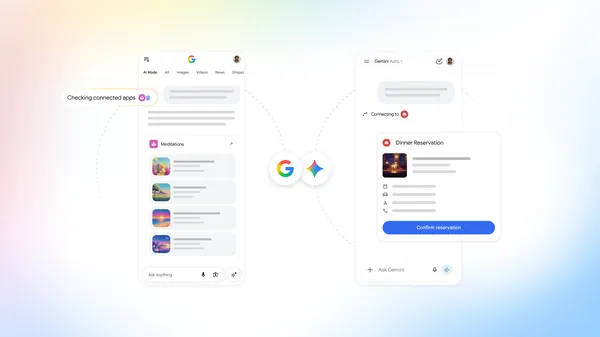
Developers can now apply to join the Connected Apps Platform, which connects Gemini with over 60 popular applications.
Google added voice-driven editing, rewriting, and formatting to gemini-3.5-transcribe and gemini-3.5-transcribe-live, letting users modify dictated speech or existing text by voice.

Google introduced the Gemini Decisions API powered by the Gemini Decision 1 model, enabling developers to evaluate up to 1,000 yes/no, choice, and rubric-scoring questions in a single multimodal pass.
Google deprecated gemini-embedding-2-preview; API calls now automatically route to gemini-embedding-2 with same schema and pricing, no re-indexing needed.
Gemini API function responses now support Office/OpenDocument files, audio, video, and file URIs, letting tools return richer data to the model.

Google's new video generation model creates 15-second clips with multi-turn editing, 30% lower pricing, and better reference adherence, now generally available via API and Cloud.
Google released voice remixing for Gemini 3.8 TTS, allowing developers to modify existing voices using text prompts to create new stored voice IDs.

Google is expanding SynthID Detector globally in English to help users verify whether images, videos, or audio clips were generated by AI.
Google is deprecating Gemini 2.5 Flash. Starting December 1, 2026, all API requests will auto-route to Gemini 3.5 Flash-Lite and be billed at its rates.
Google has moved its Computer Use tool to general availability across both the Interactions and GenerateContent APIs.

Google's Connected Apps Platform lets developers build and manage apps for Search and the Gemini app using a cloud-hosted MCP server or Android MCP.
Genie 4 is a real-time world model that generates interactive simulations with native audio and physics. It helps build safe training environments for AI agents and robots.
Google released gemini-api, a stateless, zero-dependency command-line client for the Gemini API. It lets scripts, CI pipelines, and coding agents call Gemini without SDK setup.
New paid-tier Google Gemini API projects now store Generate Content API requests by default. Developers who do not want requests logged must opt out per request or in the dashboard.
The Gemini API now accepts PowerPoint (PPT), OpenDocument Presentation (ODP), and OpenDocument Spreadsheet (ODS) files as input, plus page-image processing for Word (DOC) files.
Google has deprecated Gemini 2.5 Pro and removed it from Google AI Studio. Starting December 1, 2026, all API requests will automatically route to Gemini 3.8 Flash and be billed at Flash rates.